
Restaurant Food Inflation: How to Protect Margin When Ingredient Prices Spike
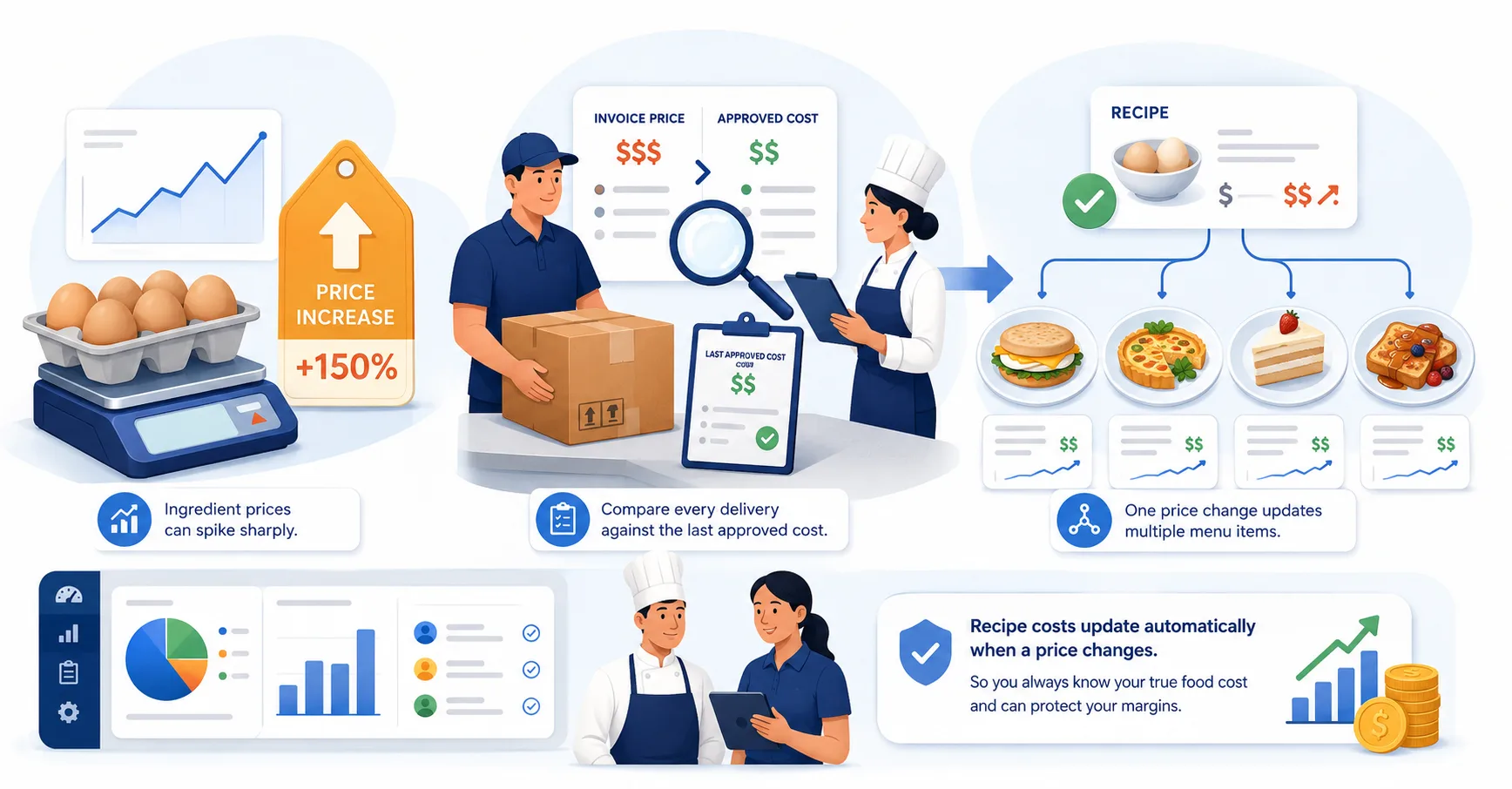
In March 2025, the average retail price of a dozen Grade A eggs hit $6.23 in the United States, with cartons in New York and California running $8.85 to $10 — according to the U.S. Bureau of Labor Statistics. That followed an earlier spike in early 2023, when avian flu outbreaks forced the culling of roughly 40 million egg-laying hens and pushed prices to $4.82 a dozen, a 150% year-over-year increase — the largest annual jump on BLS record. Restaurants and bakeries that build recipes around eggs didn't get a say in the timing. The invoice just showed up higher.
Food inflation isn't a once-a-decade event anymore. It's a recurring operating condition — driven by weather, disease outbreaks, fuel costs, and supply chain disruption — that independent restaurants have to build a response to, not just react to after the fact.
See Restaurant Food Cost & Menu Profitability: The Complete Guide for how a price spike ripples into every downstream calculation.
TL;DR
- Ingredient price spikes are frequent and often sudden — the 2023 and 2025 egg price shocks are recent, well-documented examples, not outliers.
- The real risk isn't the price increase itself. It's the lag between when a price changes and when your recipe costs and menu prices catch up.
- Closing the gap takes a system, not a habit — see how to track food supplier price changes for how to build one.
- Not every increase requires a menu price change — sometimes the right response is a substitution, a portion adjustment, or simply absorbing a short-term spike.
Why Food Inflation Hits Restaurants Differently
A grocery retailer can reprice a shelf tag the same day a supplier cost changes. A restaurant can't do that as easily — menu prices are printed, posted online, and visible to guests in a way that makes frequent changes feel disruptive even when they're financially justified. That asymmetry is the core problem: your costs can move weekly, but your prices realistically move a few times a year.
That gap is where margin quietly disappears. A recipe costed at last quarter's ingredient prices looks fine on paper while the actual cost of producing it has already moved. By the time a monthly or quarterly P&L review catches it, the restaurant has sold weeks or months of a menu item at a margin nobody chose.
What Recent Price Shocks Actually Looked Like
The egg market is one of the most visible, well-documented examples of how fast a single ingredient can move.
The first wave (2022–2023): Avian flu outbreaks led to the culling of about 40 million egg-laying hens. By January–February 2023, the average retail price for a dozen Grade A eggs hit $4.82 — a 150% year-over-year increase, according to the U.S. Bureau of Labor Statistics, the largest annual increase BLS has on record for the category.
The second wave (2024–2025): A renewed outbreak led to the culling of more than 33 million birds between October and December 2024. By March 2025, the national average reached $6.23 a dozen, with cage-free and specialty eggs in New York and California running $8.85 to $10, according to the U.S. Bureau of Labor Statistics. Major retailers including Walmart and Kroger implemented purchase limits, and some chains, including Waffle House, added a temporary per-egg surcharge to offset the cost.
For a bakery, breakfast concept, or any menu built around eggs as a core ingredient, that's not a rounding error — it's a direct hit to recipe cost that shows up the moment the next case is ordered, whether or not the menu price has caught up. (For bakeries working out a new price, see how to price baked goods.)
The Gap Only Closes With a System, Not a Habit
The fix isn't "pay closer attention" — that's a habit, and habits break during a busy dinner rush. It's a system: the change gets caught at receiving instead of month-end review, affected recipes recost automatically instead of on a fixed schedule, and the response — absorb it, reprice, adjust the recipe, or substitute — gets decided with the full list of exposed items in hand, not a guess. How to track food supplier price changes walks through exactly how to build that system, from normalizing unit costs to setting the thresholds that flag a real price move.
None of those response decisions can be made well without knowing, in real time, which items are actually exposed to the ingredient that just moved.
A Worked Example: One Ingredient, Multiple Menu Items
Suppose a bakery's egg supplier raises the price by $1.20 per dozen — consistent with the kind of move seen during both BLS-documented spikes above. If eggs appear in a breakfast sandwich, a quiche, two cake recipes, and a French toast batter, that single price change touches five recipes at once. Recalculating each one manually means finding every recipe that lists eggs as an ingredient, pulling the old cost, applying the new cost, and updating the menu-facing food cost percentage for each — a task that's easy to skip when the kitchen is mid-service and hard to remember to circle back to later.
That's the operational reality of food inflation: it's rarely one clean number to update. It's a chain reaction across a menu, and the chain is only as fast as your slowest recipe to get recosted.
Frequently Asked Questions
Is food inflation temporary or something restaurants should plan around permanently? Food inflation is both, in different ways — individual price shocks, like an avian flu outbreak, are typically temporary and driven by a specific event. But the pattern of recurring shocks across different ingredient categories (eggs, dairy, proteins, produce) is structural enough that building a response process is worth doing once, rather than treating each spike as a one-off emergency.
Should every ingredient price increase trigger a menu price change? No — a menu price change is one of several valid responses, and it carries guest-facing friction that other responses don't. Reserve it for increases that look sustained and for items where the margin impact is significant enough to matter. For smaller or likely-temporary increases, absorbing the cost short-term or adjusting portioning may be the better call.
How do I know if a price increase is temporary or structural? Track the ingredient's price history over time rather than reacting to a single invoice. A spike tied to a specific, known event (weather, disease outbreak, a documented supply disruption) is more likely to normalize. A price that keeps climbing across multiple delivery cycles without an obvious cause is more likely structural and worth a menu-level decision sooner.
What's the fastest way to know which menu items are exposed when a supplier price changes? The dependency has to be visible before the price changes, not reconstructed after — every recipe needs to record which ingredients it uses so that a price update can be traced to every affected item automatically. Dinezy calculates recipe cost from the ingredients and yield you define, so that connection already exists by the time a price changes.
Key Takeaways
- Ingredient price shocks are recurring, not rare — the BLS-documented 2023 (150% YoY) and 2025 egg price spikes are recent proof, not historical outliers
- The real risk is the lag between a price change and when your recipe costs and menu prices catch up — not the price change itself
- Closing the gap takes a system, not a habit — catch the change at receiving, recost affected recipes automatically, and choose a deliberate response (absorb, reprice, adjust portion, or substitute)
- A single ingredient price change can touch many recipes at once — the response is only as fast as your slowest recipe to get recosted
When a delivery is recorded at a new price, Dinezy recalculates every recipe that uses that ingredient automatically — so you see which menu items are exposed to a price change the same day it's recorded, not at the next scheduled review. Try Dinezy free at dinezytech.com.