
How to Reduce Recipe Portioning Errors Fast
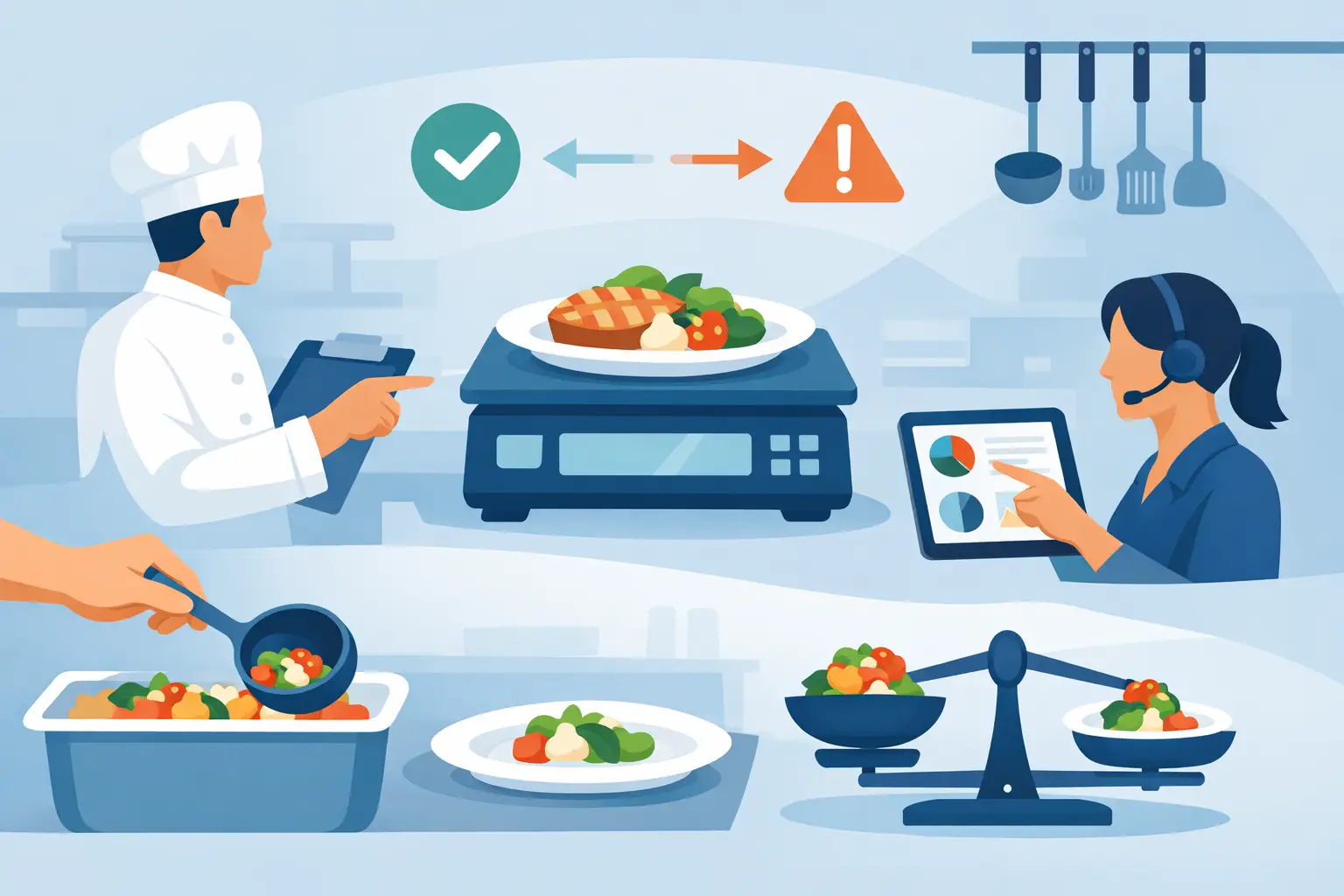
A line cook adds one extra ounce of protein to a plate. It looks generous, and no guest complains. Repeat that decision across a busy service, though, and the kitchen has quietly given away inventory that was already priced into a tight margin. The most reliable way to reduce recipe portioning errors is to make the correct portion easier to execute than the guess.
Portion control is not about asking people to be less generous or more careful. It is about creating a standard that holds up during prep rushes, shift changes, callouts, and a Saturday night with tickets printing faster than anyone wants. If the portion exists only in a manager's memory, it is not a standard. It is a variable.
Why portioning errors create larger operating problems
A portioning issue rarely stays contained to one menu item. Too much cheese, sauce, garnish, or protein changes the cost of every plate sold. Too little creates inconsistent guest experiences and often leads to remakes. Either way, the business loses control of the result.
The hard part is that portioning errors can look like ordinary waste or an unexplained inventory shortfall. A case of chicken may disappear faster than expected, but the source may be an oversized scoop, an uncalibrated scale, a prep batch that yielded fewer portions than planned, or a recipe card that leaves room for interpretation. Counting inventory shows what remains. Standard portions help explain why it remains.
For multi-unit operators, variation compounds. One location may serve a six-ounce protein portion while another serves closer to seven. Both teams may believe they are following the recipe. Without a defined, measurable specification and a way to verify it, the brand is paying for inconsistency at every location.
Start with a portion standard people can execute
The best recipe specification answers the questions a cook has at the station, not just the questions a chef has when developing the dish. Use a weight or volume that can be measured with the actual tool available during service. Terms such as a handful, a generous scoop, or a light drizzle invite different interpretations from different people.
For each ingredient that materially affects cost, quality, or presentation, define the portion in the unit used at the station. A burger should state the cooked or raw patty weight, depending on how the operation portions it. A salad should specify ounces of greens and dressing, not simply a bowl of each. A pasta dish should identify the ladle size or weighed sauce portion and the finished pasta amount.
The recipe should also establish the condition of the ingredient. Is the portion measured before cooking or after? Is it drained, trimmed, packed, sliced, or loose? A four-ounce portion of diced tomatoes means something different when excess liquid is included. These details are where margin protection is won or lost.
Match the tool to the specification
A precise recipe with the wrong utensil still produces inconsistent plates. If a station needs a five-ounce sauce portion, provide a marked ladle or portion cup that reliably delivers it. If the amount must be weighed, keep a functioning scale at that station rather than expecting staff to walk across the kitchen during service.
Scoop numbers can work well for products with consistent density, such as ice cream or prepared fillings. They are less dependable for loose products that pack differently, such as shredded cheese or leafy greens. In those cases, weighing the portion is usually the better control.
Do not add tools merely to make a process look disciplined. A scale can slow a high-volume station if the menu item does not require that level of precision. The standard should reflect the ingredient's cost, the menu item's volume, and the risk of variation. Reserve the tightest controls for ingredients where a small overportion has a meaningful margin impact.
Control the batch yield before service begins
Many portioning problems begin in prep, not on the line. A batch recipe may list its ingredients perfectly, yet the operation does not know how many sellable portions the finished batch should produce. Without a yield, staff can portion by instinct and still believe they followed the recipe.
Every batched item should state the expected number of portions produced. For example, if a prepared dressing batch is intended to yield 48 two-ounce servings, the container should be labeled with the batch date, total yield, portion size, and the tool used to serve it. The same principle applies to soups, sauces, braises, rice, pre-portioned proteins, and dessert components.
Batch yield is also the bridge between recipe cost and execution. Total batch cost divided by portions produced establishes the ingredient cost per serving. If the batch consistently produces fewer portions than the recipe states, the operation should investigate the cause rather than simply accepting a higher cost. Evaporation, trimming, transfer loss, overfilling portion cups, and incorrect prep measures can each change the result.
This is where current supplier costs matter. When the price of an ingredient changes, the recipe cost should change with it, so operators can see which menu items need attention. Dinezy supports standardized recipes and current supplier-cost tracking, giving operators one source of truth for the expected cost and portion standard behind each item. The kitchen still has to execute the standard, but the standard is no longer disconnected from the cost.
Make recipe cards useful at the station
A recipe card buried in a binder cannot control a busy shift. The team needs a clear version where the work happens, with enough detail to produce the same result without asking a manager.
Use a consistent layout across recipes. Put the finished yield near the top. List ingredients in the order they are used, include exact measurements, and call out the portions that are easy to miss. A photo of the finished plate can help with visual consistency, but it should support a measurable specification, not replace one.
Keep prep recipes and assembly recipes separate when they serve different purposes. The prep cook needs batch quantities, process steps, hold instructions, and total yield. The line cook needs the portion tools, assembly sequence, and finished presentation. Combining both into one dense page often leads people to skip the information that matters to their role.
When a recipe changes, remove ambiguity immediately. A new protein portion, sauce ladle, or garnish amount should be treated as an operating change, not casual kitchen communication. Document the update, train the affected teams, and review whether each location has responded. A message in a group chat may spread news, but it does not create a dependable record of adoption.
Verify portions in the normal flow of work
Training establishes the expectation. Verification keeps it from drifting. Managers should build short portion checks into prep and service instead of waiting for monthly food-cost results to reveal a problem.
At prep, weigh several portions from each batch before the product is put away. On the line, spot-check high-cost items at different points in a shift, especially after a new employee takes over a station or a rush has changed the pace. The goal is not to catch someone doing something wrong. It is to find whether the system gives them a practical way to do it right.
Record recurring misses by item and cause. If portions are consistently large, look first at the tool and recipe language. A scoop may be the wrong size, containers may be overfilled, or a stated ounce amount may not match the visual expectation set by the plated photo. Coaching matters, but repeated errors are often process design failures.
Manager approval also creates accountability. When authorized staff submit count-based inventory records and managers review them, the operation has an auditable trail for what was counted and approved. Pair that discipline with portion checks, and food-cost conversations move from assumptions to specific operating facts.
Know when the standard needs to change
Not every difference is an execution failure. A seasonal product may arrive with a different moisture level. A new supplier pack may change trim loss. A menu item may be redesigned because guests consistently leave part of it behind. In those cases, forcing the old portion can create a different problem.
Review the standard when the change is intentional and repeatable. Test the new recipe, establish the revised batch yield, update the cost, replace the station documentation, and communicate the change consistently. Do not allow informal workarounds to become the permanent version of a recipe.
The strongest portion control systems make good execution ordinary. Give the team a clear number, the right tool, a usable recipe, and a manager who checks the work. Then the restaurant can run the same on the days the owner is not in the store.
Frequently Asked Questions
How is a portioning error different from ordinary waste? A portioning error and ordinary waste can look identical from the numbers alone — a case of chicken disappearing faster than expected might be an oversized scoop, an uncalibrated scale, or a recipe card that leaves room for interpretation, rather than spoilage. Counting inventory shows what remains; a measurable portion standard helps explain why.
Should I use a scoop or a scale to control a portion? Use a scoop for products with consistent density, like ice cream or prepared fillings, and a scale for loose products that pack differently, like shredded cheese or leafy greens — the right choice depends on the ingredient's density and how it packs. Don't add a scale to a high-volume station if the item doesn't need that level of precision — it just slows the line.
How do you catch portioning drift before a monthly food-cost report shows it? Build short verification checks into the normal flow of work instead of waiting for month-end. Weigh a few portions from each batch at prep, and spot-check high-cost items on the line at different points in a shift, especially after a new employee takes a station or a rush changes the pace.
How does batch yield affect portion cost? Batch cost divided by the number of portions produced gives the cost per serving. If a batch consistently yields fewer portions than the recipe states, the per-portion cost rises even though the recipe itself never changed — which is why tracking actual yield, not just the ingredient list, matters.
Key Takeaways
- A portioning problem often looks like ordinary waste or a mysterious shortfall until it's traced to a specific tool or recipe gap
- Match the control to the ingredient — scoops for consistent-density products, a scale for loose or variable ones
- Verify portions in the normal flow of work, at prep and on the line, instead of waiting for a monthly report to reveal drift
- Batch yield determines portion cost directly: fewer portions from the same batch means a higher cost per serving, even with an unchanged recipe
Dinezy stores every recipe's portion sizes and batch yield in one place, and recalculates the cost per portion automatically whenever a supplier price changes — so the standard on the recipe card and the number behind your margin never drift apart. Try Dinezy free at dinezytech.com