
How to Calculate Restaurant Food Cost Percentage
Most restaurant owners know the basic formula for food cost percentage. The problem is applying it wrong — and getting numbers that make your operation look more profitable than it actually is. Food cost percentage is one of the most critical metrics in your business, but a small mistake in the calculation can hide thousands of dollars in waste, spoilage, or untracked shrinkage. Here's the correct way to calculate it, why the common shortcut fails, and what to do when your number comes back too high.
This formula is the entry point to a bigger system — see Restaurant Food Cost & Menu Profitability: The Complete Guide for how it connects to prime cost, menu-item profitability, and concept-specific benchmarks.
TL;DR
- The basic formula (COGS ÷ Sales × 100) gives wrong results if you skip the inventory adjustment step.
- The correct formula accounts for what you actually used, not just what you purchased.
- For most independent F&B operators — restaurants, cafés, bakeries, and tea shops — food cost typically falls between 20–30%.
- When food cost is too high, the problem is almost always over-ordering, waste, or portion inconsistency.
The Formula Everyone Teaches (And Its Fatal Flaw)
Food cost percentage tells you what portion of your food revenue went toward food itself. The formula most people learn is:
Food Cost % = (Cost of Goods Sold ÷ Food Sales) × 100
For a single dish, the same idea works per recipe: divide cost per serving by menu price. The free recipe cost calculator does that in your browser.
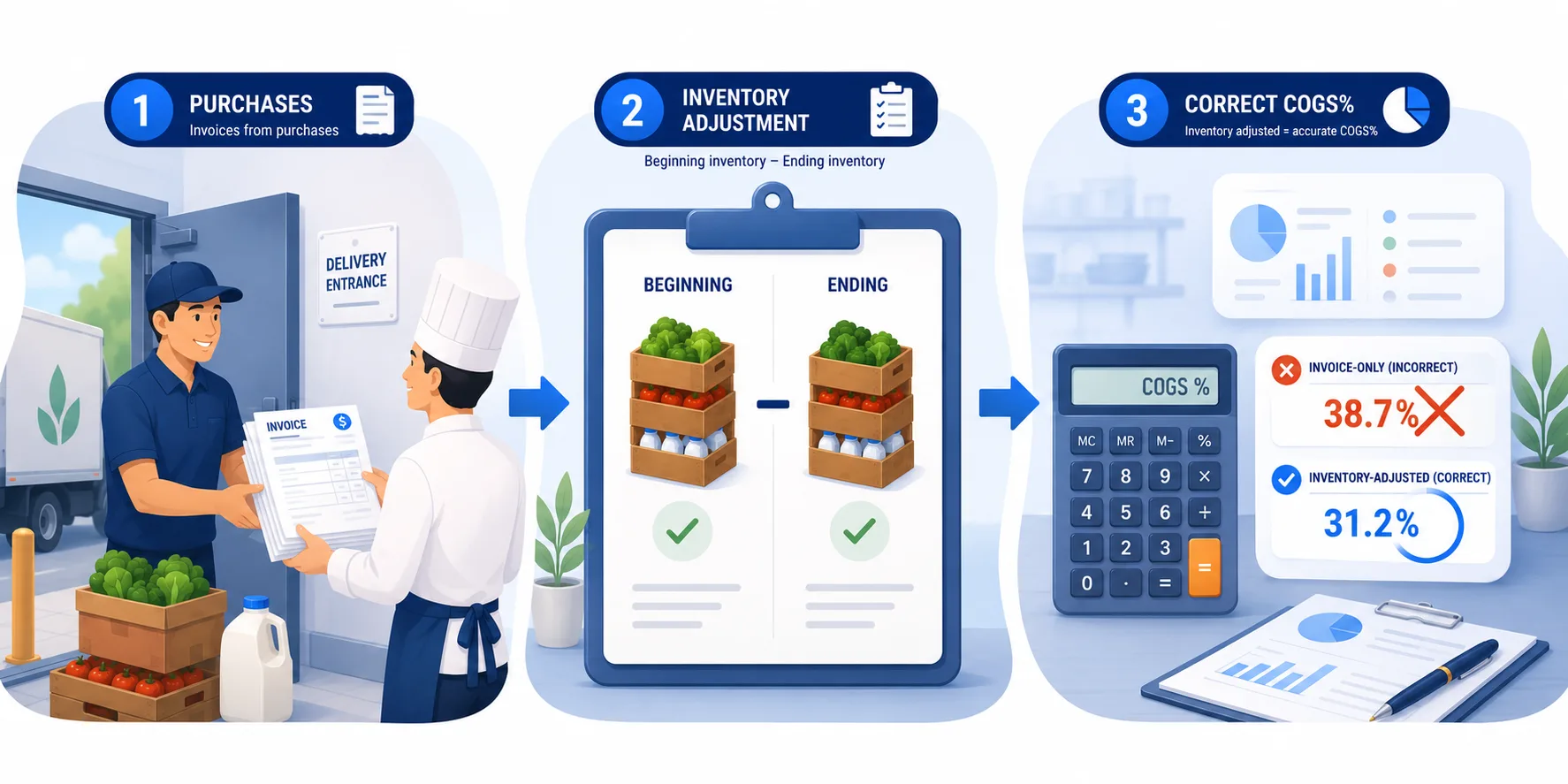
The problem: most operators plug in their invoice totals for COGS. That's your purchases — not your actual consumption. If you bought $12,000 in ingredients this month but $2,000 is still sitting in your walk-in, you didn't actually use $12,000. Your real food cost is closer to $10,000.
Using purchase totals instead of actual consumption inflates your food cost percentage and makes it impossible to catch spoilage, theft, or over-ordering.
The Correct Formula (With Inventory Adjustment)
The accurate formula is:
Food Cost % = (Beginning Inventory + Purchases − Ending Inventory) ÷ Food Sales × 100
This gives you the cost of what was actually consumed during the period — not just what arrived at the back door.
Worked example — wrong way:
- Monthly food purchases (invoices): $12,000
- Food sales: $38,000
- Calculated food cost %: $12,000 ÷ $38,000 × 100 = 31.6%
Worked example — correct way:
- Beginning inventory: $4,500
- Purchases: $12,000
- Ending inventory: $6,200
- Actual COGS: $4,500 + $12,000 − $6,200 = $10,300
- Food sales: $38,000
- Correct food cost %: $10,300 ÷ $38,000 × 100 = 27.1%
That's a 4.5 percentage point difference. On $38,000 in monthly sales, the gap between these two numbers is roughly $1,700. If you're making decisions based on the wrong number, you're flying blind.
Why Most Independent Operators Can't Apply This Formula
Notice that the correct formula requires three specific inputs: beginning inventory value, total purchases, and ending inventory value. Purchases are easy — you have the invoices. But most independent operators don't have accurate beginning and ending inventory values on hand — see Restaurant Inventory Valuation: The Complete Guide for how those two numbers actually get calculated.
Without a consistent counting process, you have two bad options: guess at inventory values, or skip the adjustment entirely and fall back on invoice totals. Either way, your food cost number is wrong.
This is the gap that separates operators who manage food cost from those who just monitor it. The formula is simple. Getting the inputs right is the actual work.
What's a Typical Food Cost for an Independent F&B Operator?
For most independent food and beverage businesses — full-service restaurants, cafés, bakeries, and tea shops — food cost typically falls between 20–30%. Use this as a directional benchmark, not a hard target. Your actual number depends on your menu mix, price point, and how precisely you're measuring.
If your food cost is consistently above 30%, something specific is driving it. The answer is almost never "your prices are too low." It's usually a process problem — over-ordering, waste, or portion inconsistency.
The #1 Mistake: Using Invoice Totals Instead of Actual Consumption
This bears repeating because it's the most common error across independent restaurants. When you use invoice totals:
- Inventory sitting in storage looks like a cost
- A big produce order in week four skews the whole month
- Spoilage becomes invisible — food you threw away looks the same as food you sold
The fix is a physical inventory count at the beginning and end of every period you're measuring. Weekly is ideal. Monthly is the minimum to get a meaningful number.
3 Things to Do When Your Food Cost Is Too High
1. Run a waste log for two weeks. Have every station track what gets thrown away and why — spoilage, wrong orders, trim waste. You'll quickly see whether the problem is over-ordering, poor FIFO rotation, or prep inconsistency. See How to Reduce Food Waste in Your Restaurant for a full breakdown.
2. Audit your portion sizes. Weigh proteins and high-cost ingredients for one full week. Even a 10% over-pour on an 8-oz protein across 200 covers a week adds up to significant cost. Compare what your recipe cards say against what's actually going out.
3. Cross-check your top 10 ingredients. Pull your POS sales mix, calculate the theoretical usage of your top 10 ingredients based on recipes, and compare that to what you actually ordered. A significant gap between theoretical and actual usage is a signal — either the recipe isn't being followed, portions are off, or there's unaccounted shrinkage.
Frequently Asked Questions
How often should I calculate my food cost percentage? Weekly is best for active management. Monthly is the minimum for meaningful trend data. If you're only looking at food cost quarterly, you're catching problems too late to fix them without real financial pain.
Should I calculate food cost by category (food vs. beverage) or as one number? By category if possible. Beverage costs — especially specialty drinks — are very different from food costs. Mixing them into one number makes it harder to identify where problems are coming from.
What's the hardest part of calculating food cost correctly? Getting the inventory numbers. The formula itself is simple — the hard part is having accurate beginning and ending inventory values for each period. Without a consistent counting process, you're either estimating or skipping the inventory adjustment entirely, which means you're back to using invoice totals as a proxy for COGS.
My food cost percentage looks fine but I'm still losing money. Why? Food cost is only half the picture. Prime cost — food cost plus labor cost — needs to be under 65%, ideally 55–60%. A 28% food cost paired with 45% labor cost still puts you in serious trouble. Always look at prime cost alongside food cost.
Key Takeaways
- Use the inventory-adjusted formula: (Beginning Inventory + Purchases − Ending Inventory) ÷ Food Sales × 100
- Never substitute invoice totals for actual COGS — it produces inflated, misleading numbers
- For most independent F&B operators, food cost falls between 20–30%
- When food cost is high, audit waste, portions, and actual vs. theoretical ingredient usage
- The formula is only as good as your inventory data — consistent counting is the prerequisite
Applying the correct formula requires three inputs: beginning inventory, ending inventory, and purchases. Dinezy tracks your period start and end values automatically from your counts and totals your purchases for any date range you filter, so you're not rebuilding the formula in a spreadsheet each period. Try Dinezy free at dinezytech.com.