
Restaurant Task Assignment: Why It Doesn't Scale
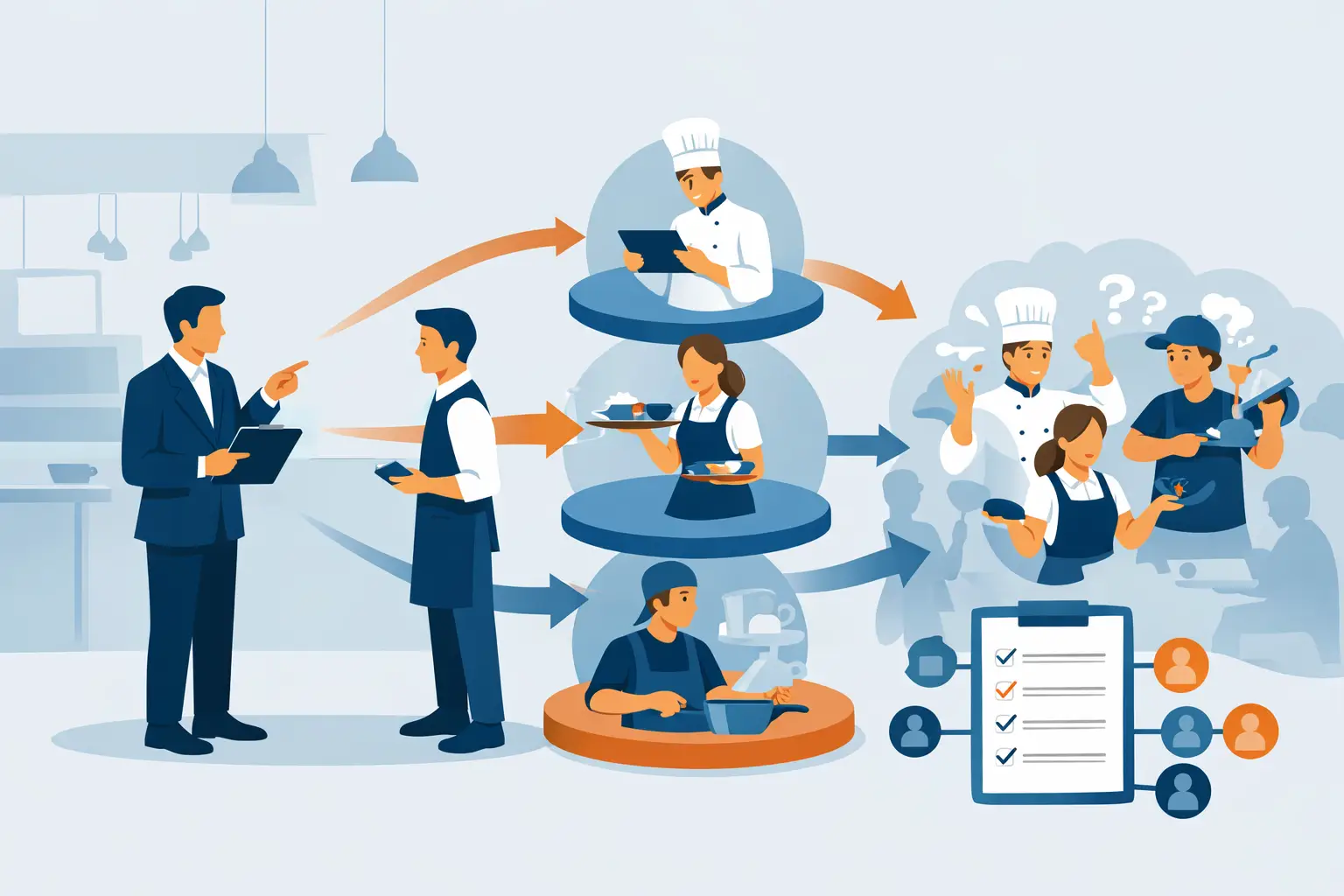
"Can someone restock the walk-in before we open" said to the room at large is not a task assignment — it's a request that three people can each assume someone else picked up. Restaurant task assignment breaks down for a structural reason, not a discipline problem: as soon as a team runs more than one shift, verbal delegation stops reaching everyone it needs to reach, and nothing about it is written down for the person checking in six hours later.
TL;DR
- Verbal task delegation doesn't scale past a single shift because there's no record of who owns what, and no way to check completion after the fact.
- The core requirements for a task to actually get done are a named owner, a visible deadline, and a way to confirm it happened — not just that someone was told.
- A group chat message solves the "telling" problem but not the "confirming" problem — it still relies on someone remembering to check back.
- Dinezy's Checklist module assigns individual items to specific team members, tracks completion per item, and routes the finished list to a manager for review.
Why Verbal Delegation Breaks Down as You Grow
A single-shift operation with two or three people can run on verbal handoffs because everyone is in the same room and the owner can watch the work happen. That model stops working the moment a second shift, a second station, or a manager's day off enters the picture.
Three failure patterns show up almost every time:
Diffusion of responsibility. When a task is announced to a group instead of assigned to a person, each individual can reasonably assume someone else is handling it. Nobody is lying or being lazy — the request genuinely had no owner.
Shift handoff gaps. A task mentioned at the end of the morning shift needs to survive a handoff to the afternoon shift, often to people who weren't in the room when it was said. If the closing manager doesn't personally repeat it, it's gone.
No completion signal. Even when someone does the task, there's often no way for the person who asked to confirm it happened without physically checking. That means managers either re-verify everything themselves or find out it didn't happen the next time it matters.
None of this is about staff not caring. It's what happens when accountability depends on memory instead of a record.
What Makes a Task Assignment Actually Work
A task that reliably gets done has three things a verbal request usually doesn't:
- A named owner — one specific person, not "whoever's free" or the group as a whole.
- A visible deadline or window — so the owner and the manager both know when it's due, not just "at some point today."
- A completion status someone else can check — without needing to track the person down or physically inspect the result.
A group text or messaging app can carry the first two if someone writes it carefully, but it rarely carries the third — a message sitting unread in a busy thread looks identical to one that was seen and ignored. For a closer look at how that compares to paper-based systems specifically, see paper checklists vs. digital procedures.
This is also a different problem from getting staff to notice a message in the first place — see how to get restaurant staff to actually read announcements for that side of team communication.
How Dinezy's Checklist Builds Restaurant Shift Accountability
Dinezy's Checklist module is built as a kitchen accountability tool: it assigns individual items to the specific team member responsible for them, rather than posting a list and hoping the right person picks up each line. Each item carries its own completion status, so a manager can see exactly which items on a list are done and which aren't without walking the floor to check.
Once the list is complete, it routes to a manager for review — creating a record of who did the work and who signed off on it, instead of a verbal assurance that "it's handled." This is separate from Dinezy's inventory count workflow, which uses its own submit-and-approve process rather than upfront assignment — see restaurant inventory management software for how that works.
For lighter-weight items — a single reminder locked to one person with a start and end date, rather than a multi-item recurring list — Dinezy's Bulletin Board can post a task-type message targeted to that individual. It's a different tool for a different shape of problem: Checklist is built for structured, repeatable work with item-by-item completion tracking; Bulletin Board is built for a single, time-boxed reminder. When the question isn't who owns a job but how much of a shared job is done, like 100 croissants split across two shifts, see restaurant task tracking.
Frequently Asked Questions
What's the actual difference between assigning a task and just telling someone to do it? An assignment ties a specific piece of work to a specific person with a status that stays visible after the conversation ends. Dinezy's Checklist items work this way — each one is assigned to the person responsible, and its completion status is visible to anyone reviewing the list, so accountability doesn't depend on someone remembering who they told.
Can I assign items on the same checklist to different people? Yes — each item on a Dinezy checklist is assigned individually, so a single list, like an opening checklist, can have different items owned by different team members rather than one person being responsible for the whole thing.
How can restaurant owners delegate operating decisions without losing accountability? Delegating a decision works when it carries the same three things any task assignment needs: a named owner, a visible deadline, and a completion status someone else can check. Dinezy's Checklist module builds all three in — each item is assigned to one person, carries its own due window, and routes to a manager for review once it's marked complete, so delegating doesn't mean losing track of whether it actually happened.
How do I know a task was actually completed and not just marked done? Once a checklist is completed, it goes to a manager for review before it's treated as finished. That review step is where accountability comes from — the same way Dinezy's inventory counts are submitted by staff and then reviewed and approved by a manager, rather than being taken at face value the moment they're marked complete.
Is this the same as Dinezy's Bulletin Board? No — task assignment and Bulletin Board solve related but different problems. Checklist is for structured, multi-item work with per-item completion tracking and manager review — think opening and closing procedures. Bulletin Board is for posting a message or a single task to a targeted audience with response tracking — see how to get restaurant staff to actually read announcements for that use case.
Key Takeaways
- Verbal task delegation fails at scale because it lacks an owner, a deadline, and a completion signal that survives a shift change.
- Diffusion of responsibility is a structural outcome of group requests, not a reflection of staff effort.
- A working assignment needs three things: a named owner, a visible deadline, and a completion status someone else can verify.
- Dinezy's Checklist module assigns items to specific people, tracks completion per item, and adds a manager review step before a list counts as done.
Dinezy's Checklist module replaces "I told someone" with a record of who owns each task, whether it's done, and who reviewed it — so accountability doesn't depend on who remembers what. Try Dinezy free at dinezytech.com.