
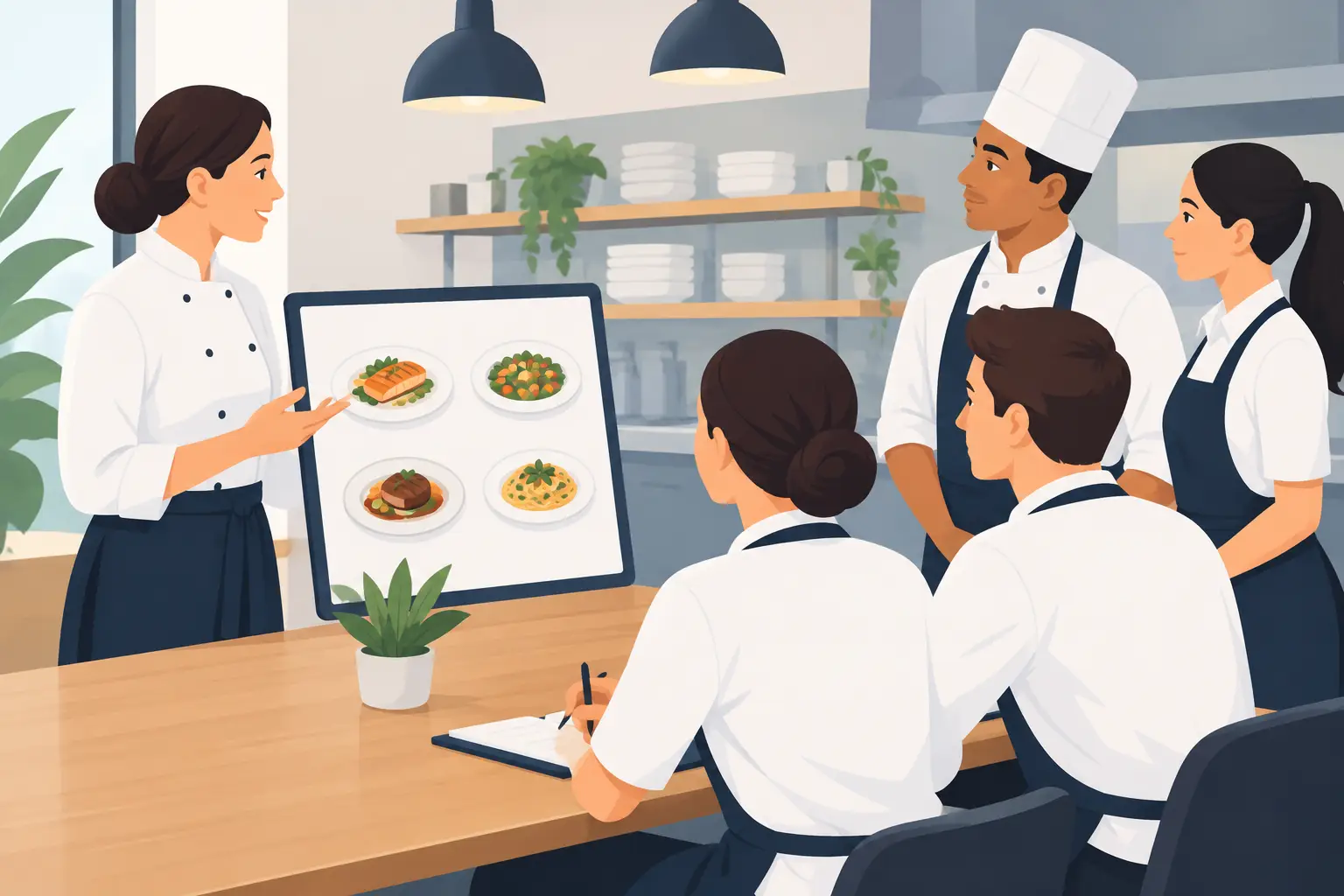
How to Train Restaurant Staff on a New Menu
The new menu launches Monday. On Thursday, the chef walks the lunch crew through the eight new dishes. The dinner servers get a printed sheet. The weekend bartender hears about it from a coworker. On Monday night, a guest asks whether the new risotto has dairy, and the server who was off on Thursday guesses.
Most new menu training doesn't fail because the training was bad. It fails because it only reached the people who happened to be there, and nobody could tell who was ready and who wasn't.
TL;DR
- New menu training should cover what changed, how each dish tastes and is described, ingredients and allergens, how it's plated or poured, and how it's priced.
- The hardest part of a restaurant menu rollout isn't teaching. It's reaching every shift and knowing who is actually ready.
- Run it in stages: announce the change early, train in tastings, check knowledge before launch, and keep a quick reference for the first week.
- Training is done when each person is ready, not when the meeting ends.
- Dinezy's Bulletin Board lets you announce the change, ask each person to mark their training done, and see who still needs to finish before launch.
Why New Menu Training Falls Short
Staff work different shifts. One tasting session reaches one shift. The rest of the team gets a summary, a photo of the menu, or nothing.
Hearing it isn't the same as knowing it. A server who listened to the chef describe eight dishes once won't remember which three contain nuts by Saturday.
The launch date sneaks up. Training gets squeezed between a busy weekend and the first night of the new menu, and it's the first thing cut when the week gets tight.
Nobody tracks who's ready. The chef knows who came to the tasting. Nobody knows who didn't, who has questions, or who is still guessing.
The result is a menu launch where half the team can sell the new dishes and the other half avoids recommending them.
What New Menu Training Should Cover
Before you plan the sessions, decide what every person needs to know. For each new or changed item:
- What it is. Name, a one-line description, and the main components.
- How it tastes. Ideally in their own words, after tasting it.
- Ingredients and allergens. What's in it, what can be left out, and what can't.
- How to sell it. One sentence for the table, and what it pairs with.
- How it's made or plated. For the kitchen: the recipe, the portion, and how it should look at the pass.
- Price and modifiers. What it costs, and any add-ons or substitutions.
- What's gone. Items coming off the menu, so nobody keeps offering them.
For the kitchen, the most important piece is a standardized recipe for every new dish, so each cook makes it the same way; see why restaurants need standardized recipes.
How to Train Restaurant Staff on a New Menu, Step by Step
1. Announce the change early
At least a week before launch, tell the whole team what's changing and when: new dishes, items coming off, the launch date, and when training happens. People prepare better when they aren't surprised.
2. Train the kitchen first
The kitchen needs to execute the new dishes before the floor can sell them. Walk the line through each recipe, cook each dish together, and agree on how it should look before it goes out.
3. Hold tastings for the floor
Tasting is the single most effective part of menu training. A server who has tasted the dish describes it with confidence. Run more than one tasting if your team works different shifts, and keep each one small enough that everyone actually tastes.
4. Give everyone a quick reference
A one-page sheet with each dish, its description, key ingredients, allergens, and price. It should be easy to check on a phone in the middle of a shift.
5. Check knowledge before launch
A short quiz, a role-play at the table, or a manager asking two questions during pre-shift. The goal isn't to catch people out; it's to find who needs another five minutes before guests start asking.
6. Confirm everyone is ready
Before launch night, you should know who has finished training and who hasn't. The people who missed the tasting are exactly the ones who will be guessing on Monday.
7. Follow up in the first week
Use the pre-shift meeting to cover one or two new dishes each day, answer questions that came up at the tables, and fix anything that isn't landing.
Don't Just Announce the Change. Make Sure the Team Is Ready for It.
The gap in most menu rollouts is between "we told everyone" and "everyone is ready." An announcement covers the first part. The second part needs each person to finish their training and a manager to see who hasn't.
That's two different things, and it helps to treat them that way: one message to tell the team what's changing, and one task that each person completes when they're ready.
Where Dinezy Fits
Dinezy's Bulletin Board handles both halves of a menu rollout:
- Announce the change once. Post the launch date and tasting times as an Announcement to the stores and roles the change affects, pin it, and see who has tapped Confirm Read.
- Schedule it ahead. Write the launch announcement now and set it to appear on the day it matters.
- Fill the tastings. Post each tasting as an RSVP with a cap on seats, so sessions don't overflow and you know who is coming.
- Make training a task. Post "Complete new menu training" as a task that each person marks Done once they've tasted the dishes and reviewed the reference sheet, and see who still needs to finish before launch.
For training that has several steps and needs a manager to sign off on each one, Dinezy's Checklist is the better fit. For keeping the new dishes consistent once they're live, the recipes live in the same app. For more on getting updates read, see how to get restaurant staff to read announcements.
Frequently Asked Questions
How do you train restaurant staff on a new menu? Announce the change early, train the kitchen first, hold tastings for the floor, give everyone a quick reference sheet, check knowledge before launch, and confirm each person has finished training. Follow up in pre-shift meetings during the first week.
How long before launch should new menu training start? Start at least a week before launch for a full menu change, so you can run tastings for every shift and catch the people who missed the first one. A single new dish can be trained in a few days.
What should new menu training include? For each item: what it is, how it tastes, ingredients and allergens, how to describe and pair it, how it's made and plated, and the price. Include which items are coming off the menu so nobody keeps offering them.
How do you make sure every staff member is trained on the new menu? Treat training as something each person completes, not a meeting they attend. Run more than one tasting, give a quick reference, check knowledge with a short quiz or role-play, and keep track of who has finished. With Dinezy's Bulletin Board, each person marks a training task Done, and you see who still needs to finish.
How do you announce a menu change to restaurant staff? Tell the whole team at least a week ahead, in one place everyone checks: what's new, what's coming off, the launch date, and when training happens. Pin it until launch, and check who has confirmed it. For wording ideas, see restaurant staff announcement examples.
Key Takeaways
- New menu training covers what each dish is, how it tastes, ingredients and allergens, how to sell it, how it's made, and the price.
- The hard part of a menu rollout is reaching every shift and knowing who is ready.
- Announce early, train the kitchen first, hold tastings, give a quick reference, and check knowledge before launch.
- Training is done when each person is ready, not when the meeting ends.
Don't just announce the change. Make sure the team is ready for it. Dinezy's Bulletin Board announces the new menu, fills your tasting sessions, and shows who has finished training before launch night. Try Dinezy free at dinezytech.com